Start a loyalty programme that pays for itself
Every trader has two kinds of customer. There is the one who walks past on a Saturday because the market is busy and the smell is good, and there is the one who plans their week around your food. The first one pays for the day. The second one pays for the slow months, the rainy Tuesday, and the week the big event down the road pulls half your crowd away.
A loyalty programme is how you turn more of the first kind into the second. Done well it is close to free, because you pay for it out of food rather than out of cash. Done badly it is a standing discount you hand to people who were coming back anyway. The difference is entirely in how you set it up, so it is worth an hour of thinking before you switch anything on.
Why a regular is worth more than a new face
Winning a new customer costs you something every single time: a stall fee at a busier market, a boosted post, a sample handed out, or simply the price of standing in a spot with more foot traffic. Getting an existing customer back costs you a reason. That is the whole economics of loyalty, and it is why the number that matters is not how much someone spends per order, it is how often they come.
The maths is friendlier than most traders expect. A well built programme costs roughly 2 to 3 percent of revenue and breaks even at around two extra visits per member per year. Not two a month. Two a year. Everything past that is profit you did not have before.
The one decision that makes or breaks it
Reward with food, never with money off. This is the decision that separates a programme that funds itself from one that bleeds. R65 off an order costs you R65. A free R65 plate costs you what the ingredients cost, which for most kitchens is somewhere around a third of the menu price. The customer values the two identically. You do not.
“A rand off costs you a rand. A free plate costs you what it costs you to make.”
That single choice moves the break-even from roughly thirteen percent more visits to roughly four. It is why every coffee shop on the planet runs a stamp card and none of them run cashback. It is also why YesChef has no option to convert stamps into a rand discount: the moment you can, the case for running the programme at all falls over.
What a good programme actually looks like
- It is built into how you already take orders. A separate app or a separate card is a second thing to lose.
- The customer does nothing to join. If they gave you a phone number or signed in, they are already earning.
- Your staff do nothing to run it. Nothing to stamp, nothing to remember, nothing to be nice about at the wrong moment.
- The customer can do the arithmetic in their head. Buy nine coffees, get one free, is a card people play. A points balance nobody can convert is a card people forget.
- You can see what it costs you before you switch it on, and what it earned you afterwards.
Pick your counting rule first
YesChef gives you two ways to count a stamp, and picking the right one is mostly about how much your basket varies.
Count every visit when what people buy from you swings around. A burger, a combo and a family order are all one visit, and nobody on your team has to decide what half a portion is worth. A minimum order value keeps a cooldrink from earning the same stamp as a full meal, and we pre-fill that from your own trading.
Count every item when you sell one thing over and over. This is the classic punch card: three flat whites in one order is three stamps, because the card is about coffees. You pick which menu items the card is about, and an item bundled inside a combo still counts.
How to start, in six steps
- Choose the reward. Pick items off your own menu. Something people already want, not the thing you are trying to shift.
- Set the stamp cost. The page suggests a number and shows you the band it will accept, so a number it offers is a number that will save. Buy nine, get one free is always allowed.
- Set a minimum order to earn, so a stamp keeps meaning a real visit.
- Set a minimum spend to redeem. This is the one people skip and regret. Without it, a customer claims a free item on a bare order and you pay the ingredients plus the platform fee for nothing.
- Decide which order sources earn. Orders from your QR menu always carry a phone number, so those always land. Kiosk and walk-in orders only earn when your staff actually ask for a number.
- Read the cost panel, then switch it on. It reads your last 90 days of completed orders and tells you what the programme costs as a share of revenue and how many extra visits it needs to pay for itself.
The trap is picking a reward that is too cheap. A R30 side on a R290 average basket costs you well under one percent of revenue, which sounds like a bargain right up until you notice nobody is chasing it. You end up paying for a card nobody plays, which is the worst outcome available. If the panel says your programme is on the dear side, add a stamp or two rather than pulling the reward.
What your customers see
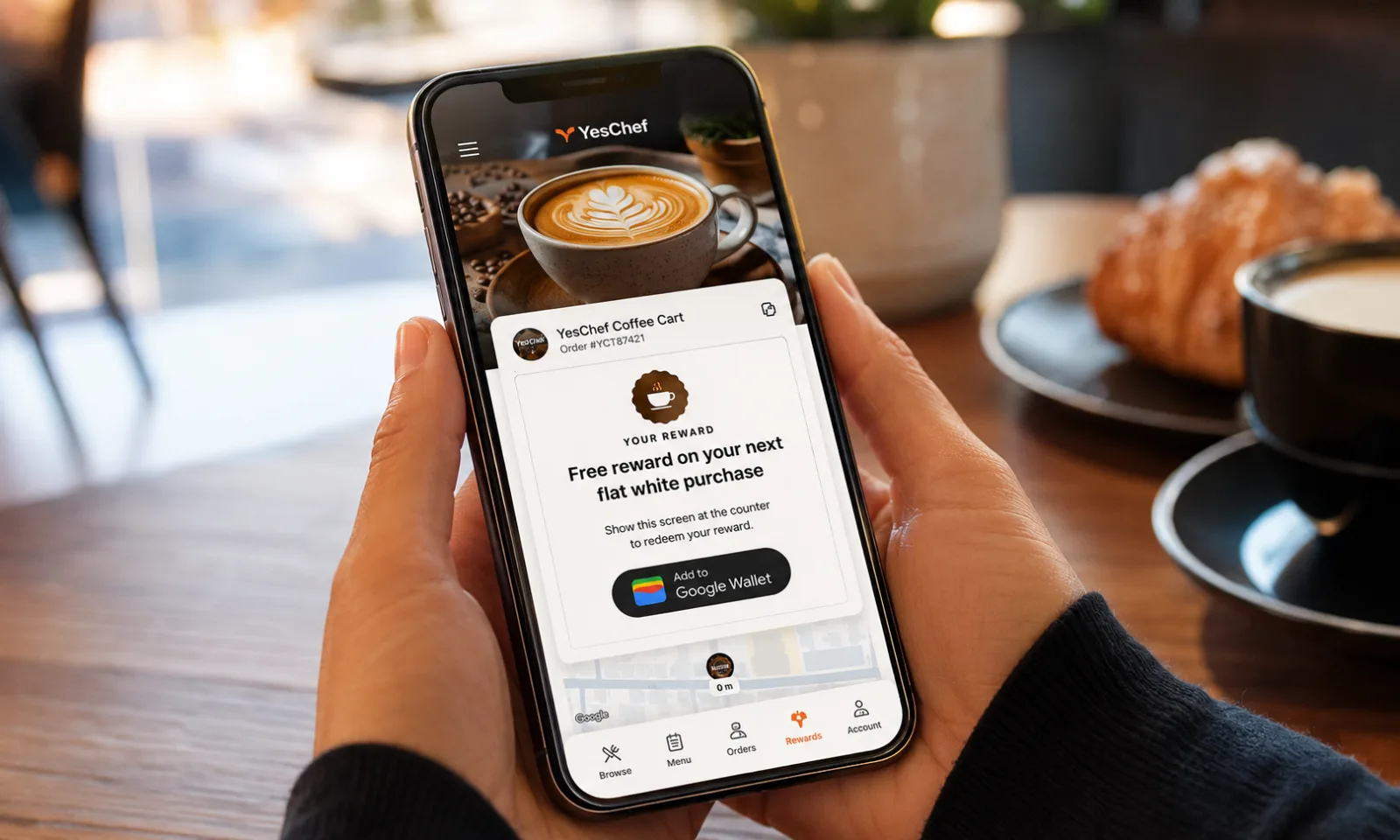
On your menu they see their own standing, and only when there is something worth saying: three more visits for a free Boerie Roll, with a progress bar. Someone who is not signed in sees what the card is and what fills it. At checkout, anyone who can already claim a reward gets a picker, and the free item comes off at what your menu charges for that item, size upgrades included, extras not.
They also get a quiet Rewards chip on your card in the YesChef directory when they have stamps with you. That is the moment loyalty stops being a nice idea and starts changing which queue somebody joins.
Then measure it, and be patient
Your loyalty report shows members, new members this month, stamps outstanding, and what those stamps would cost you to honour. It gives you two numbers for that liability on purpose: what the outstanding stamps are worth at menu prices, and what they would actually cost you in ingredients. A vendor who only looks at the first number overestimates what they owe by roughly three times and switches a working programme off.
The number that answers the real question is visit lift: how often members order compared with everyone else. It stays blank until enough customers sit on both sides of the comparison, because a lift figure built from four people is worse than no figure at all. Give it a couple of months of trading before you judge it.
The reward you do not have to fund
Alongside your own card there is a platform one that costs you nothing. Every tenth order a customer places through YesChef, we waive our own service fee on it. You are paid exactly as normal. It is our money, so it runs at every vendor whether or not you run a card of your own, and it is one more reason for a customer to come back through YesChef rather than wander.
Questions traders ask
- Does this work if I only trade weekends? Often not. A customer who visits once or twice a month takes months to reach a reward at a normal stamp count, and nobody stays interested that long. Set a smaller card, or leave it off and lean on the platform rewards instead. The page will tell you honestly which side of that line you are on.
- Do customers need an app? No. They order from their browser, and stamps are tied to their phone number or their account. When they sign in later, stamps sitting against that number come with them.
- What happens to stamps if I change the reward? Nothing you have already promised. A reward's stamp cost is stored on the reward, so stamps someone has already collected keep buying what they were told they would buy. New pricing applies from then on.
- Can I take a break? Pause it. Earning stops and redemptions are still honoured, so nobody loses what they worked for.
- Do stamps expire? Only through inactivity. The clock runs from the customer's last stamp, not from each individual one, so an active regular never loses a card. Someone who has not been near you all window is retired overnight, and what they already spent is never clawed back.
- Which plan do I need? Any of them, including Lite. You fund the rewards out of your own margin, so it would be strange for us to charge you for the privilege.
A loyalty card is not a discount you are forced into by the stall next door. It is the cheapest way to buy a second visit from someone who already likes your food, paid for in ingredients rather than cash. Set the reward properly, put a floor under it, and let the numbers tell you in two months whether it worked.
Put it into practice
Start free, build your menu, and take your first order today.